.svg)


.svg)




Event Registration Guide
1. Capacity limits
Capacity limits are useful for restricting the number of attendees at an event or for specific registration options within an event, allowing for better control.
When is it sensible to use capacity limits?
Capacity limits are particularly useful when the available capacity is restricted. They can also help increase demand through scarcity — see also the section on “Increasing the number of event registrations.”
What are the advantages of capacity limits?
With capacity limits, you can better manage the number of participants at your events. This gives you improved planning reliability for the entire event or for individual programme items. Capacity limits also ensure that overbooking cannot occur.
What are the disadvantages of capacity limits?
Once the capacity limit for your event has been reached, no further participants can register. This may result in losing potential interested guests. Even when taking the no-show rate into account, it may happen that the desired capacity is not fully reached. A waiting list can help mitigate this.
What should you keep in mind when using capacity limits?
Try to plan your event as flexibly as possible. If demand exceeds your capacity, you can make short-term adjustments to your event concept. If demand is lower, adjust your event location or order quantities accordingly. Note that if you display the number of available places on your event website and there are only a few registrations at the start, this may have a discouraging effect on potential participants.
2. Waiting list
A waiting list gives interested guests the option to add themselves to a list when an event or a specific registration option is already fully booked. Guests on the waiting list can then be offered a place if cancellations free up spots.
When is it sensible to use a waiting list?
A waiting list only makes sense in combination with capacity limits and if there is a reasonable chance that registered participants may cancel. It is useful when demand for your events or a specific registration option exceeds the available supply.
What are the advantages of a waiting list?
A waiting list allows you to capture potential interested guests for your event or individual registration options. It helps you track excess demand and adjust your event configuration to better align with the actual interest.
What are the disadvantages of a waiting list?
Activating a waiting list naturally raises hopes among participants that a place will become available. If this does not happen, it can lead to disappointment.
What should you keep in mind when using a waiting list?
It makes sense to define not only the main capacity but also the number of places on the waiting list. An unlimited waiting list, as mentioned, can lead to frustration among your target audience. Consider how many places on the waiting list are realistic — in other words, how many spots are likely to become available. For a place to free up, registered participants must also have the option to cancel. Often, participants only decide a few days before the event whether they can attend. For this reason, it is advisable to send a reminder email ahead of the event, highlighting the cancellation option.
Can a waiting list be automated?
Yes, a waiting list can be automated. An event registration software such as Oniva offers an automatic waiting list. When a registered participant cancels, the first person on the waiting list receives an automatic invitation to register for the event. If they do not register within the defined timeframe, the second person is offered a place, and so on.
3. Sessions
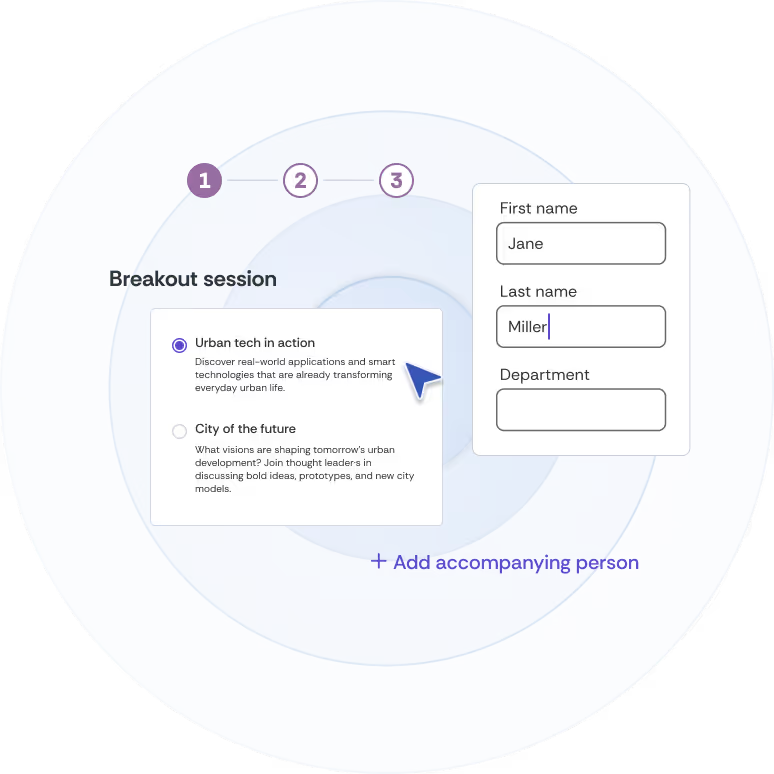
Sessions are individual programme elements within an event that help structure the overall programme. They can add variety, such as through breakout sessions, or offer individually selectable options.
What should you consider for sessions?
Sessions provide participants with the opportunity to make individual choices. The challenge often lies in planning capacities in advance, as the exact interests of participants are not yet known. A survey before event registration can help address this and provide valuable information for better planning.
4. Accompanying persons
Accompanying persons are additional people that participants can register during an event sign-up. The number of accompanying persons can vary depending on the event concept, from one to several.
What should you consider for accompanying persons?
Typically, all event communication is directed only to the main participant, i.e., the person who completed the event registration. This is also important for data protection reasons, as accompanying persons cannot give consent for event communication and data collection.
It’s also important to note that the registered accompanying person may change up until the event date. Participants should therefore have the option to update the information regarding their accompanying persons.
At event entry, registrations with accompanying persons can add extra complexity, for example, if the accompanying person does not arrive at the same time as the main participant.
5. Registration form
The registration form is used to collect the necessary information for event participation. Digital registration forms typically include at least the participant’s first name, last name, and email address.
What information should be requested in the registration form?
As a general rule, less is more. Limiting the form to only the essential fields increases the registration rate and helps comply with data protection requirements. Nevertheless, depending on the event, additional information may be needed to ensure smooth participation—for example, to correctly process catering orders based on dietary preferences or to send information to participants’ smartphones during the event. Keep in mind that the registration form collects personal data, so your data protection policy must include participants’ consent.
What are additional queries in the registration form?
Additional queries are necessary pieces of information (such as dietary preferences) that participants must provide for event participation. Another example could be whether the registration includes attendance at a dinner.
6. Registration deadline
The registration deadline determines the latest date by which participants can sign up for an event. In practice, a distinction is often made between the date by which event organisers expect a response and the actual deadline for registration. Setting an early registration deadline can provide organisers with greater planning certainty. However, an early deadline may also prevent late-interested participants from registering.
Which registration deadline should be set?
The actual registration deadline depends on the event concept. If you need to inform your event suppliers of the number of participants and this has cost or resource implications, it is advisable to agree the deadline with your suppliers. For events where this is not a factor, you can keep registration open until the event date, allowing for spontaneous registrations.
7. Cancellation deadline
In addition to the registration deadline, a cancellation deadline can also be set. Participants can cancel their registration up until this deadline. Cancelling after the deadline may incur costs, as reducing the number of guests at this stage can lead to charges from event suppliers.
Which cancellation deadline should be set?
The cancellation deadline primarily relates to resource planning and should therefore be agreed with your event suppliers. If your event planning is flexible, it is advisable to keep the cancellation deadline open until the day of the event. This can help achieve a lower no-show rate.
How can event registrations be increased?
A high registration rate is crucial for well-attended business events. By strategically applying psychological techniques, you can significantly boost both interest and registrations. Here, we present seven effective methods from behavioural psychology that you can implement at your next event with minimal effort.
1. Social Proof
People tend to follow the behaviour of others. Use social proof by displaying a guest list of those already registered on your event website. Make sure to obtain the consent of participants before publishing their names. Additionally, you can showcase testimonials and feedback from previous attendees.
Highlight the participation of important or high-profile guests attending your event. Statistics such as “Over 1,000 registrations in the first 7 days” can also be very effective.
2. Scarcity
The fear of missing out (FOMO) is a strong motivator. Create a sense of scarcity by limiting the number of places for your event or, for paid events, by highlighting early-bird discounts. Ideally, use an event solution like Oniva, which allows you to display available places in real time on your event website. Phrases such as “Only 10 tickets left!” or “Early-bird tickets available until the end of the week!” can encourage potential attendees to register more quickly.
3. Reciprocity
The principle of reciprocity suggests that people feel obliged to return a favour. Offer your potential attendees something valuable, such as a giveaway, a free e-book download, or an exclusive webinar or on-site meeting if they register early for your event. This gift can motivate your audience to show appreciation by signing up.
4. Commitment
Once people commit to something, they are more likely to follow through. Leverage this by offering potential attendees small, non-binding steps leading up to the full event registration. A classic example is sending a “Save the Date,” which creates an initial connection. Another option is an “early-bird” registration, where interested individuals sign up for updates and are later prompted to complete full registration.
5. Liking
People are more likely to be persuaded by individuals they like. Build a relationship with your audience by being authentic and approachable as an event organisation. Use social media to introduce yourself and your team, share personal insights about event planning, and engage directly with potential attendees.
6. Authority
Authority and credibility are crucial for building trust. Showcase the expertise of your organisation or your speakers. Use certificates, awards, and other credentials to underline your competence. The participation of renowned experts or high-profile individuals in your events will also strengthen the perception of your event.
7. Combine the methods for maximum impact
The true power of these techniques lies in their combination. For example, use Social Proof and Scarcity together by linking testimonials with statements such as “Places are filling up fast!” Or combine Reciprocity and Commitment by offering a free e-book and asking interested parties to sign up for updates.
By strategically applying these seven principles, you can not only increase interest in your event but also boost the number of event registrations. Remember that people respond to these psychological triggers, so use them skillfully to your advantage.
How can the complexity of event registration be reduced?
While a simple event registration can be set up quickly, complexity can increase rapidly when different registration options are required for various target groups. In this article, we will guide you step by step on how to successfully manage this event complexity.
Step 1: Create a clear layout
Before configuring the event registration itself, it is important to create a clear layout. Start by identifying the different target groups for whom the event is relevant. These could be internal employees, external clients, or special VIP guests. Once the target groups are defined, list all possible registration options relevant to each group. This could include the choice of different sessions, days, or additional services such as hotel stays. Also consider any extra information you may need from participants, such as dietary preferences or other special requirements.
Another important step is to identify dependencies and rules. There may be certain restrictions or conditions that need to be observed, such as specific sessions being bookable only for certain target groups.
Step 2: Create a booking matrix
Once all relevant information has been gathered, it is helpful to create a booking matrix. This matrix serves as a visual representation of the different registration options for each target group. Such a matrix allows you to structure the booking logic clearly and identify potential problems or gaps in the registration process early on. An example of a booking matrix could look as follows:

Step 3: Configure the event registration
After creating the booking matrix, the next step is to configure the event registration accordingly. Using suitable event management software is advantageous, as it can map out complex logic. If you are currently using a CMS for event registrations and wondering whether to switch, our article on CMS vs. dedicated event registration software walks you through the key differences and when a dedicated solution makes sense. Ideally, the event tool should offer flexible capacities, the ability to configure different permission groups, and adaptable registration forms.
If you are not using dedicated event management software, it is important to design registration separately for each target group. This means creating separate registration forms and individual event websites for each group. However, keep in mind that this can quickly lead to a loss of overview and control over the registration process.
Step 4: Consider multilingual needs
Another challenge in event registration is multilingualism, particularly if target groups communicate in different languages. In this case, it is important to choose an event tool that allows seamless integration of multiple languages. This helps avoid creating multiple registration forms per target group and reduces complexity.
Step 5: Test and review
Before promoting your event, it is essential to thoroughly test the various “user journeys.” Ensure that all conditions and rules are correctly configured and that the registration process runs smoothly. This also includes checking the registration forms to ensure all required information can be captured accurately.
By following these steps, you can effectively manage the complexity of event registration and ensure a smooth registration process for your event.
Conclusion
Event registration is one of the most important factors in determining the success of your event. It ensures planning reliability and provides participants with a smooth experience. By making targeted use of capacities, waiting lists, and clearly structured sessions, you maintain control over attendance and content. Accompanying guests, a clear and concise registration form, as well as registration and deregistration deadlines, all contribute to a well-organised process. Psychological principles such as social proof, scarcity, or reciprocity can also help increase registration rates.
To reduce complexity, it is advisable to establish a clear overview of target groups, create a booking matrix, and configure your process within a flexible event registration software. Multilingual functionality and thorough testing ensure that the registration process runs smoothly for all participants. This way, you create the foundation for a successful event where participants are satisfied and event organisers retain full control.