.svg)


.svg)

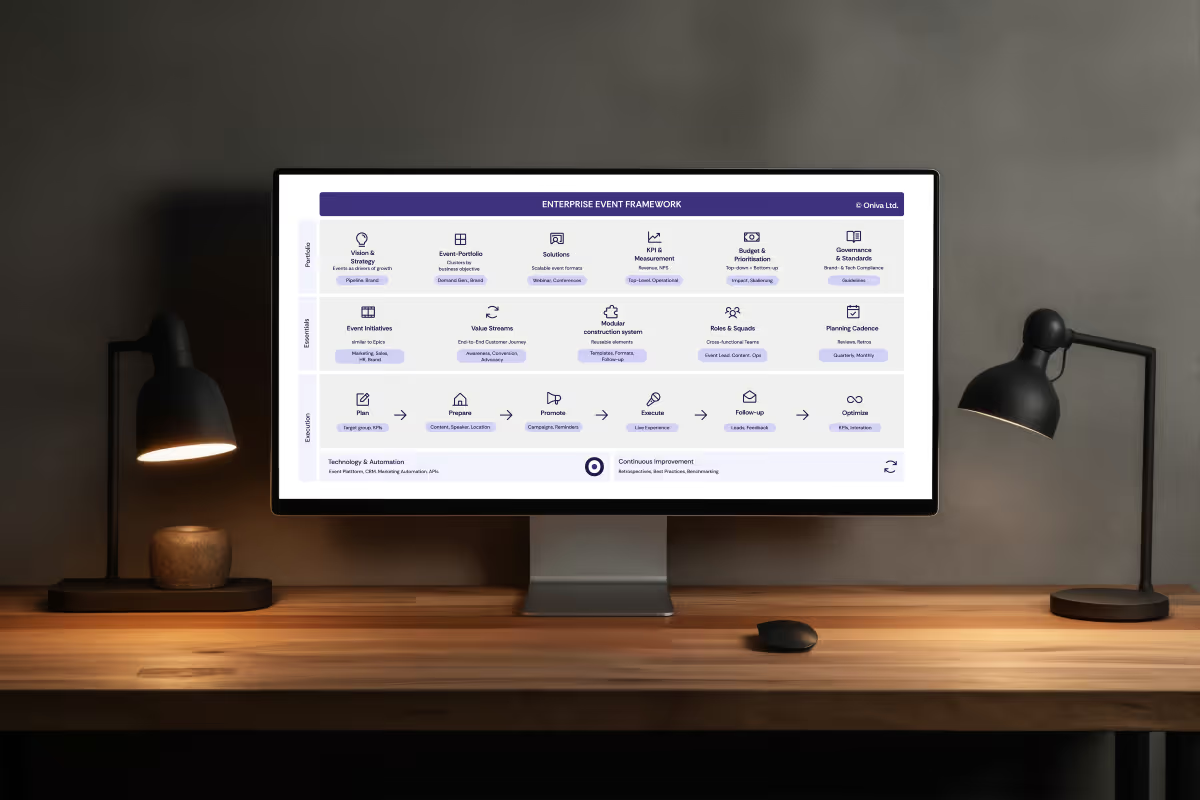


What is the "Enterprise Event Framework"?
At its core, an Enterprise Event Framework is a structured, organisation-wide approach to planning, executing and scaling events systematically, rather than reinventing the wheel for each individual event. Derived from the Scaled Agile Framework (SAFe), the Enterprise Event Framework provides guidance for holistic event management in larger organisations. It is therefore not just about individual events, but about an operating model for events across an entire organisation.
Certain specialist terms from agile project management and B2B marketing are used throughout this article – an overview of all concepts can be found in the glossary at the end of the article.
Why do organisations need an "Enterprise Event Framework"?
An Enterprise Event Framework is an organisation-wide operating model for events that systematically governs planning, execution and scaling. Organisations need it to ensure consistency, efficiency and brand identity, to align events strategically with organisational objectives, to make success measurable and to reduce risks. At the same time, it facilitates cross-functional collaboration and creates space for innovation, rather than reinventing every event from scratch.
How did the "Enterprise Event Framework" come about?
In our daily conversations with clients at Oniva, we repeatedly observe that events in larger organisations are not thought through and managed holistically. Instead of a cohesive approach, isolated one-off solutions emerge.
As a provider of event software, this is a problem for us: fragmented processes frequently lead to unnecessarily high costs, a lack of efficiency and untapped potential within the organisation. For this reason, we decided to provide support through the Enterprise Event Framework. The model is aimed at roles responsible for events and marketing, such as the Head of Marketing, but of course also at roles involved in agile organisational development. According to our annual events survey, events are organised by a wide variety of roles.
How does the "Enterprise Event Framework" work?
In the following section, you will find an explanation of our model. Please note that, as with any model, it does not claim universal validity and will always require room for improvement and individual adaptation.
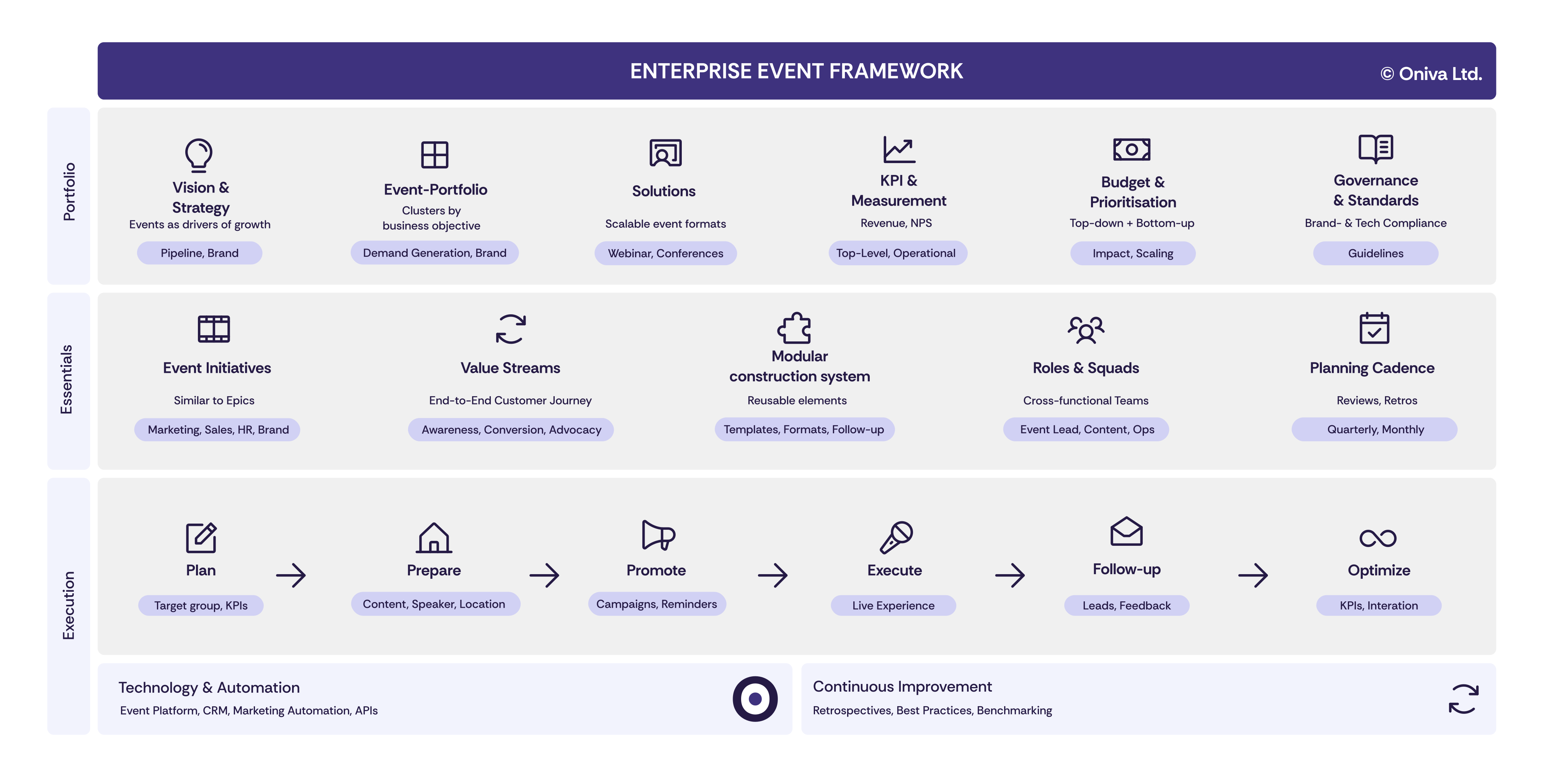
1. Portfolio level
1.1 Vision & strategy
The strategy and vision level is the starting point of the entire Enterprise Event Framework and addresses the fundamental question: why do events exist in this organisation at all, and what are they supposed to achieve?
The event vision
One possible vision might read: "Events as a scalable growth driver and experience platform." This is deliberately not an operational objective, but a strategic positioning. Events are not understood as an isolated marketing measure, but as a systematic instrument that works across multiple organisational objectives – and that is scalable, repeatable and measurable.
The four strategic roles of events
Events fulfil four clearly distinct functions within the framework, each of which justifies its own cluster and formats:
Growth (pipeline & revenue)
Events are a direct demand generation channel. Webinars, trade fairs and roadshows generate new leads, accelerate deals in the sales funnel and influence purchasing decisions. This role justifies events using hard business KPIs such as Pipeline Contribution and Cost per Opportunity.
Customer retention
Retaining and developing existing customers through exclusive experiences is often more cost-effective than acquiring new ones. Customer Advisory Boards, VIP experiences and executive events create emotional loyalty and drive expansion, as well as turning customers into active brand ambassadors.
Brand & thought leadership
Flagship events, community meetups and thought leadership formats position the organisation as a relevant player in the industry. The short-term ROI here is harder to measure, but the long-term effect on perception and trust is considerable.
Employee engagement
Internal events such as onboardings, leadership trainings and company offsites are not a "nice-to-have", but a strategic HR instrument for culture, retention and employee performance.
Why this level is decisive
Without a clear strategy and vision, events quickly degenerate into tactical actionism – events happen because they have always happened. The portfolio level forces every event and every cluster to be traced back to one of the four strategic roles. This is the basis for prioritisation in the budget section and for the entire governance model: an event that cannot be assigned to a strategic role has no place in the portfolio.
1.2 Event portfolio
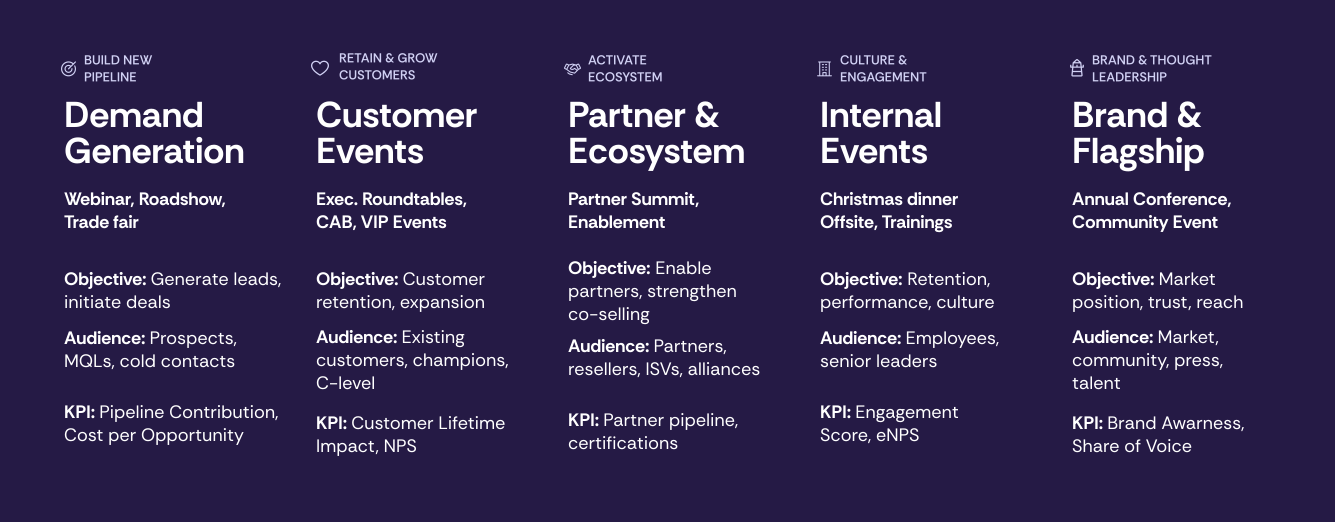
The table shows at a glance what truly distinguishes the clusters from one another. Here are the most important distinctions in detail:
Demand generation vs. customer events
This is the most common source of confusion. Demand generation targets people who are not yet familiar with the organisation or have not yet made a purchasing decision. Customer events begin precisely where demand generation ends: after the close. Packing both objectives into the same event type dilutes the message and produces neither good leads nor genuine customer intimacy.
Partner events as a separate cluster
Partners are neither customers nor prospects, but multipliers. Enabling them is a standalone strategic objective. A poorly informed partner costs more pipeline than they generate. This is why partner events require their own formats (enablement sessions, partner summits), their own content and their own KPIs such as certification rate or co-selling pipeline.
Internal events belong in the portfolio
This is often the most underestimated cluster. Onboardings, culture events, offsites and leadership trainings are not an HR sideline, but a direct investment in retention and productivity. By integrating them into the event framework, they benefit from the same modular building blocks as external events and become measurable for the first time – through the Employee Net Promoter Score (eNPS) and Engagement Score.
Brand & flagship as a long-term bet
This cluster deliberately has the softest KPIs (brand awareness, share of voice). That is not a flaw, but an honest assessment: an annual conference does not directly feed into the next quarterly deal, but it changes how the market perceives the organisation – and that is difficult to replace. The challenge in prioritisation is that this cluster must defend its place in the budget despite its softer KPIs.
1.3 Solutions
Why "solutions" and not simply "formats"?
The term is a deliberate choice: a solution has a standardised structure, a defined use case and a clear target audience. A solution is repeatable and scalable. A format is arbitrary. A solution is a product that the event team can deliver time and again without starting from scratch. This is the direct link to the modular building blocks at the essential level.
The tension between standardisation and relevance
The more standardised a format is (e.g. a webinar series), the more scalable, but also the more generic. The more individual (e.g. an Executive Roundtable), the more impactful, but also the more resource-intensive. The framework does not resolve this tension, but makes the choice explicit: high-touch formats for small, strategically important audiences; scalable formats for broad activation.
Cluster overlaps are intentional
Enablement training appears in both partner and internal events. This is not an error; it shows that the same format can serve two different clusters, provided the learning objective is clearly defined. What changes: the audience, the content and the KPI. What stays the same: the structure.
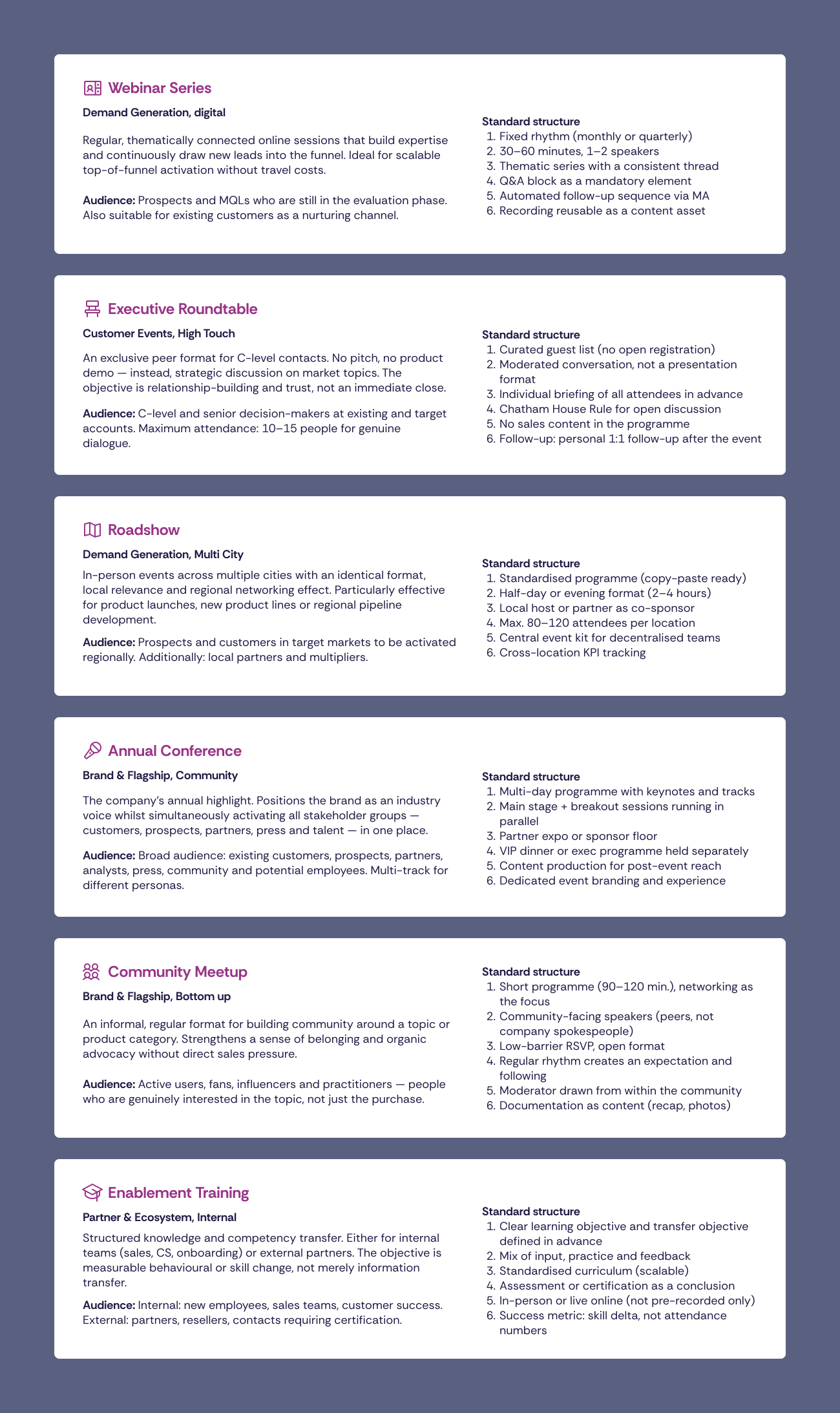
The following solutions illustrate, by way of example, how these can be structured and defined.
1.4 KPIs & measurement
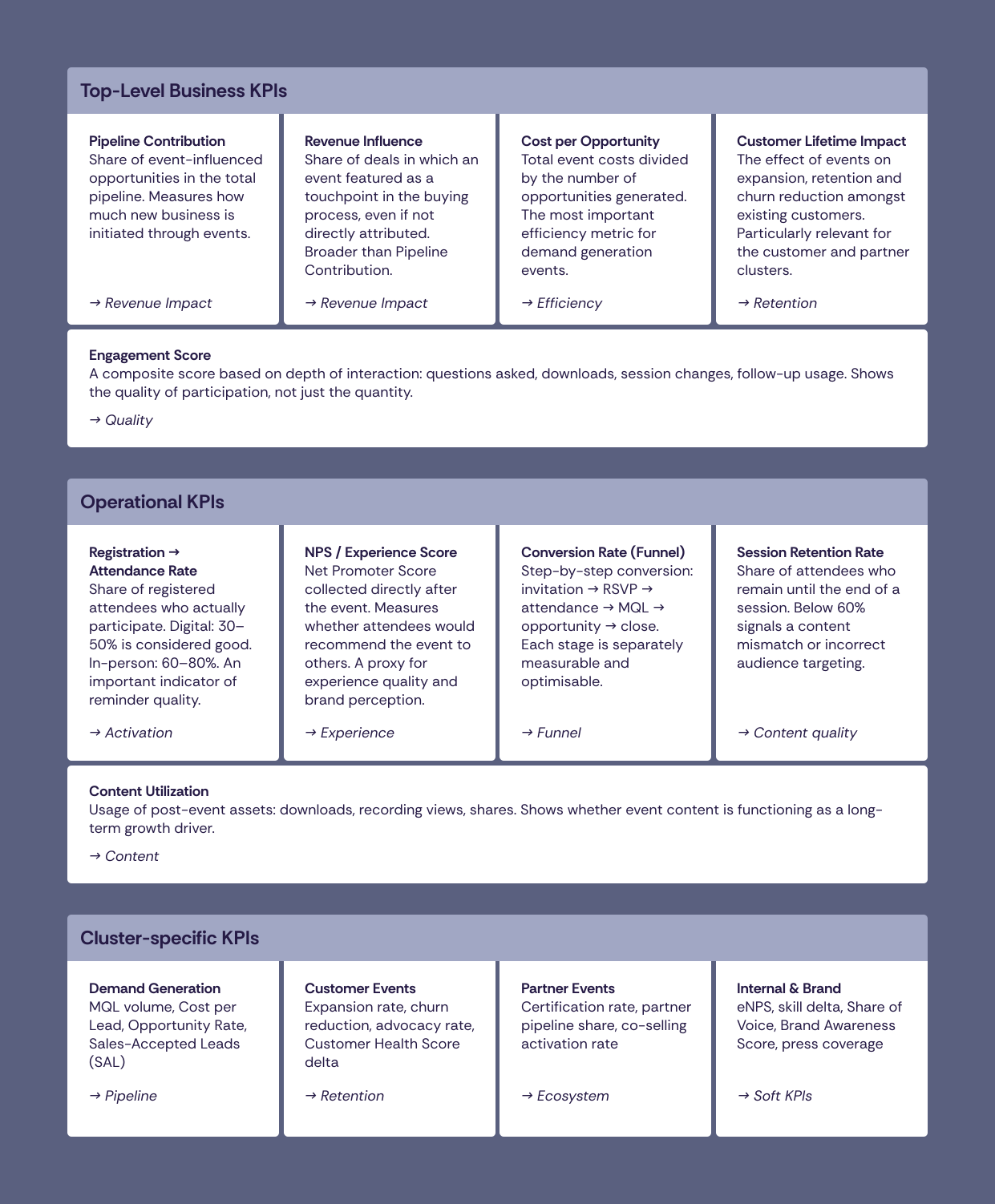
The framework is deliberately structured across three levels, each of which answers a different question. This is the key design principle behind it.
Top-level KPIs answer the question: why are we doing this?
Pipeline Contribution and Revenue Influence are the two most important KPIs, but they measure different things. Pipeline Contribution is direct: a lead came through an event, became an MQL, became an opportunity, and the event receives credit. Revenue Influence is broader: a deal had an event touchpoint somewhere in the process, even if the event was not the trigger. Together, they tell the complete story of the financial contribution. Measuring only one of them systematically underestimates the value of events.
Cost per Opportunity is the hardest efficiency metric – it forces honest prioritisation. A flagship event with a budget of £500,000 and five opportunities generated costs £100,000 per opportunity. A webinar series costing £20,000 that generates 40 opportunities costs £500. That does not mean the flagship is wrong, but it requires a different justification – through Customer Lifetime Impact, brand effects or strategic reach.
Operational KPIs answer the question: how well are we executing?
The registration-to-attendance rate is often underestimated. It is not an activation problem that only surfaces on the day of the event – it begins in the promote phase. A poor rate usually indicates either a mismatch in audience targeting at the point of RSVP, or an insufficiently robust reminder sequence. Measuring this rate systematically allows teams to course-correct during preparation.
The NPS mistake many organisations make: event NPS alone says little. An entertaining event with excellent catering generates a high NPS but no pipeline. NPS must always be considered alongside business KPIs. High NPS + zero pipeline = a good party, not a business event.
Cluster-specific KPIs solve the apples-and-oranges problem. Measuring an internal onboarding against Pipeline Contribution would be absurd, but ignoring the skill delta would be equally wrong. The framework gives each cluster its own benchmark, without sacrificing organisation-wide comparability: top-level KPIs apply to all, and cluster-specific KPIs complement them.
1.5 Budget & prioritisation
Why top-down alone does not work
A purely top-down approach means management distributes budget according to gut feeling or historical allocations. This sounds efficient, but has a systemic flaw. The people closest to customers and market developments have no influence. The result is a portfolio that replicates the last three years, regardless of whether the strategy has changed.
Why bottom-up alone does not work either
A purely bottom-up approach means every team submits its wish list. What happens? Everyone requests too much, priorities are assigned by volume of noise rather than strategic value, and the demand generation team that presents well wins out over the customer team that works more quietly but delivers higher retention impact.
The combination makes the difference
Top-down defines the overall framework and cluster weighting. This is a strategic decision that should not be democratised. Bottom-up fills this framework with concrete, justified proposals. The portfolio owner acts as arbiter when cluster budgets come into conflict. This interplay is directly analogous to the SAFe Portfolio Backlog: the framework comes from above, and prioritisation within it is achieved through structured evaluation rather than political weight.
The third factor – "strategic relevance" – is the most important tiebreaker
Impact and scalability are readily measurable. Strategic relevance is more difficult to quantify, but it prevents the framework from becoming too short-term. An event intended to open up a new market will often show low measurable impact and low scalability in its first year. Without the factor of "strategic relevance", it would be eliminated from any data-driven scoring model – even though it could be exactly what the organisation needs in two years' time. The budget framework must therefore always reflect both time horizons: short-term efficiency and medium-term strategic bets.

Typical cluster weighting (for guidance)
Demand Generation ~35%
Customer Events ~25%
Brand & Flagship ~20%
Partner & Ecosystem ~12%
Internal Events ~8%
1.6 Governance & standards
Governance is not a bureaucracy project
The most common mistake when building an event framework is over-governance: too many approval steps, too many reviews, too much centralised control. The result is a framework that slows agile teams down and that slower teams circumvent anyway. Good governance is therefore not maximum control, but minimum necessary control. Enough to ensure quality and brand consistency, yet lean enough that an experienced event squad can execute a standard webinar in two weeks without going through three rounds of approvals.
Tiering by event size is the core principle
A £2,000 meetup does not require VP approval. A £200,000 annual conference does. The framework makes this distinction explicit. This is what sets it apart from an undifferentiated "everything must be approved" approach. Budget thresholds, audience reach and strategic significance together define which approval pathway applies. The clearer these thresholds are, the fewer political discussions arise in day-to-day operations.
The tech stack is the invisible governance layer
Brand guidelines and approval processes are visible – they can be discussed and circumvented. The tech stack is structural governance: when the event management platform automatically syncs with the CRM, clean tracking is achieved without relying on individual discipline. When marketing automation sequences run centrally, brand consistency and data protection are ensured at a systemic level – not dependent on whether the individual squad remembers. This is why tech stack standardisation is often the highest-leverage governance mechanism with the least resistance.
Compliance fatigue is real and dangerous
GDPR and data protection feel like foreign bodies to event teams because they interrupt the creative flow. The solution is not an awareness campaign, but structural embedding: a compliance checklist that automatically opens with every event brief, standard contract templates that legal has pre-approved, and clear escalation paths for edge cases. What is seamlessly embedded in the workflow gets done; what is perceived as additional effort gets forgotten.
Brand guidelines – visual & communicative consistency
- Visual system: logo usage, colour palette, typography, imagery – consistent across all event materials: decks, signage, digital, merchandise.
- Naming & tone of voice: event names follow naming conventions. Communication tone is brand-compliant; no local "house style" without approval.
- Flagship vs. sub-brand: when is an event permitted to have its own event brand (e.g. an annual conference)? Clear criteria prevent brand proliferation.
- Template library: centrally maintained templates for invitations, presentations, social posts, badges and agendas – ready to use for all squads.
Experience standards – a consistent experience across all events
- Pre-event: RSVP process in no more than 3 clicks, confirmation within 5 minutes, clear logistics communication at least 48 hours in advance.
- During the event: punctual start, moderated Q&A, defined technical backup solution, live support for digital events.
- Post-event: follow-up within 24 hours, feedback survey of no more than 5 questions, recording or recap available within 72 hours.
- NPS threshold: a minimum NPS is defined per format. Falling below it automatically triggers a retrospective – no quietly ignoring it.
Tech stack requirements – platforms, tools, integrations
- Event management platform: one approved platform for as many event formats as possible (e.g. webinar tool, hybrid platform, RSVP tool). No shadow IT.
- CRM integration: all RSVPs and attendance automatically flow into the CRM. No manual exports. Touchpoint tracking is mandatory.
- Marketing automation: invitation and reminder sequences run through the central event tool. Individual Mailchimp accounts are not permitted.
- Analytics layer: a standardised dashboard template for all events. KPIs are made comparable. No individual reporting in Excel silos.
Compliance & legal – GDPR, contracts, data protection
- GDPR / data protection: obtain consent correctly at the point of RSVP, use data only for the stated purpose, observe retention periods. External event tools must have a Data Processing Agreement (DPA).
- Contracts & suppliers: standard contracts for venues, catering, AV technology and speakers. Approval thresholds: e.g. up to £10,000 event lead, up to £50,000 manager, above that VP.
- Speaker & content compliance: no external speaker material without review. No trademark or copyright infringements in presentations. In regulated industries: content approval by legal is mandatory.
- Accessibility & inclusion: physical events: check accessibility. Digital events: subtitles, recordings, time zone communication. Minimum standards are defined, not optional.
Approval process – who approves what, and when?
- Submit event brief: objective, target audience, format, budget estimate, KPI expectations. Standard form in the portfolio backlog. Without a complete brief, no review takes place.
- Cluster owner review: strategic fit, budget availability, scheduling conflicts. Takes independent decisions on events below the budget threshold.
Deadline: 5 working days. - Brand & compliance check: parallel review by the brand team (visual materials) and legal/ops (compliance checklist). Does not block the process – runs in parallel.
Deadline: 3 working days. - Portfolio owner approval: only for events above the budget threshold or with cross-cluster impact. Standard events proceed without this step.
Deadline: 5 working days. - Go/no-go & kick-off: formal approval in the portfolio backlog. The event squad receives the briefing, budget access and starts the Delivery Lifecycle.
2. Essential level
2.1 Event initiatives
Why "initiative" and not simply "event type"?
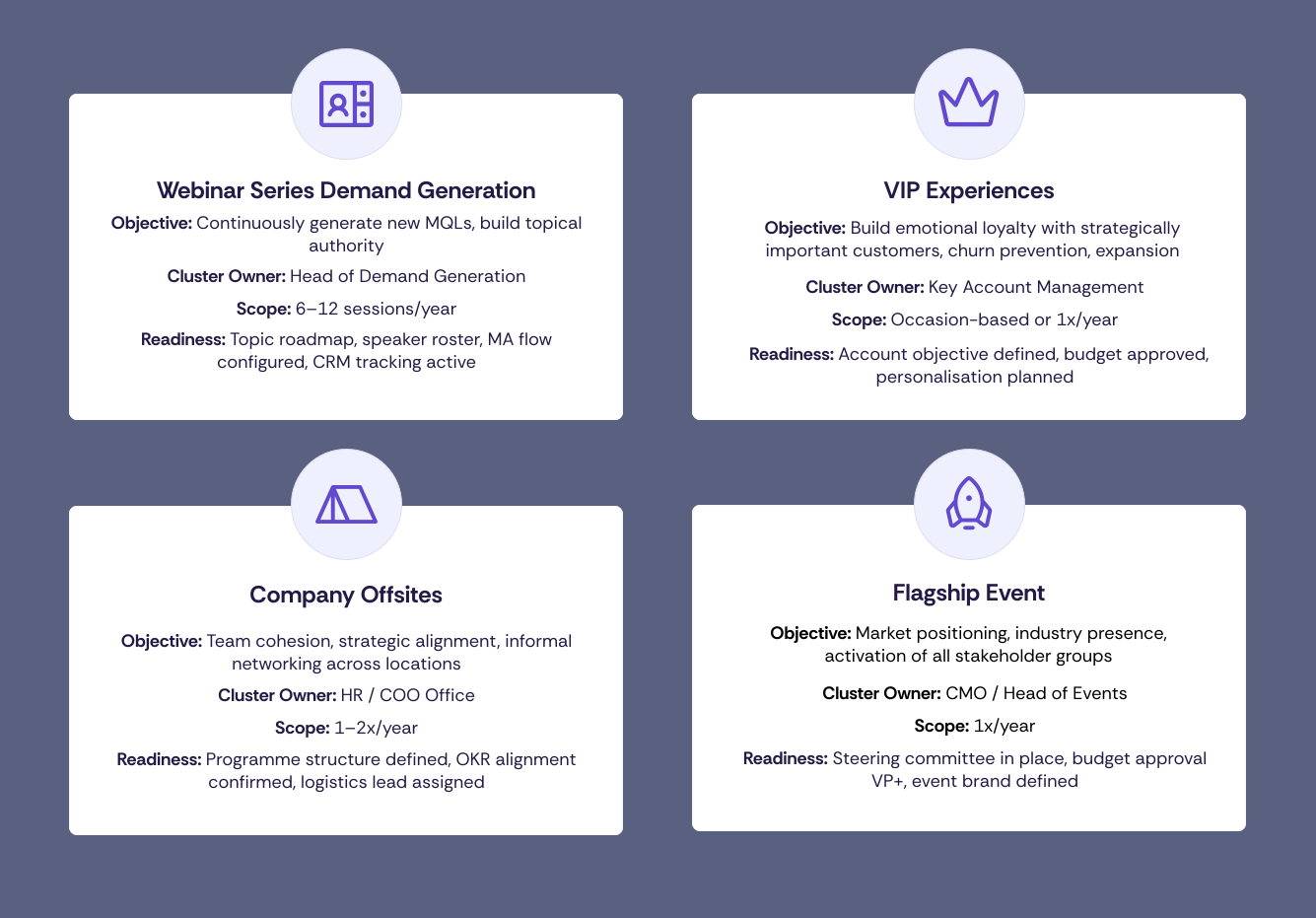
An event type is a format. An initiative is a strategic undertaking with its own business case, defined owner, measurable objective and a lifecycle that extends beyond individual events. A webinar series is not a list of twelve individual events. It is an initiative that is conceived, budgeted and operationalised once – and can then be produced repeatedly. This is the direct parallel to the SAFe Epic: too large for a single sprint, too valuable for ad hoc decisions.
The initiative funnel – analogous to the Epic Funnel
In SAFe, an epic moves through the funnel from idea, through a lean business case, to MVP and finally to implementation. An event initiative follows the same logic. The idea originates within the team, the business case is evaluated in the portfolio backlog, and the first event is the MVP. It tests the format, the audience and the response. Only once the MVP event has validated the hypothesis is the initiative fully scaled. A Customer Advisory Board that fails at its first session is not automatically repeated six more times. It is analysed, adapted or abandoned.
The readiness criteria are the quality gate
The most direct misconception about event initiatives is that budget approval equals the starting gun. In the framework, it does not. An event only launches once the readiness criteria are met – specifically: the target account list is in place, the MA flow is configured, and CRM tracking is active. Without these prerequisites, even the best event format will not produce usable results.
Cluster owner assignment is strategic, not organisational
It is worth noting that the "Customer Advisory Board" initiative sits with Customer Success and Product, not with Marketing. This is deliberate: ownership follows the primary strategic value, not the department that organises events. The event team is the enabler and producer, but the content owner is the person who carries the business case and is accountable for the KPIs. This separation of production and ownership is one of the most important structural decisions in the framework.
2.2 Value streams
The value stream is not a funnel – it is a cycle
The classic depiction of the customer journey as a funnel is misleading, because it implies that the journey ends at the point of purchase. In the event framework, advocacy is the phase that generates new awareness. A customer who speaks at a meetup or brings a prospect to a reference dinner restarts the cycle for that prospect from the beginning. Events are the only channel that can actively accelerate this cycle, because they create physical or digital spaces in which customers and prospects naturally come together.
The most critical transition zone lies between consideration and conversion
This is the point at which most event programmes have a break in continuity. Consideration events such as webinars generate leads, but if those leads are handed over to sales cold – without event context – the trust that has been built is lost. The transition only works if the account manager knows which sessions the contact attended, which questions they asked and what interest they signalled. This requires clean CRM tracking and a defined lead handover mechanism. Both are governance tasks, not something the event team can improvise.
Retention events are systematically underestimated
Organisations that analyse their event calendar typically find that 70–80% of events are aimed at awareness and consideration, and fewer than 20% at retention. This is a mistake, because the cost of losing a customer through churn typically exceeds the cost of acquisition. A customer who regularly attends enablement trainings and user conferences demonstrably churns at a lower rate than one without event touchpoints. This is measurable in CRM data – and therefore something that can be argued to a CFO.
Advocacy is the only phase with positive feedback
Every other phase "consumes" budget to generate results. Advocacy is the only phase in which well-cultivated customers actively generate new awareness and pipeline without proportionally increasing costs. An active speaker programme with ten customer speakers at external conferences generates more credible market presence than ten times the budget spent on paid sponsorships. This is the strategic reason why the advocacy phase does not sit at the end of the framework, but is conceived as a feedback loop back to awareness.
1. Awareness - making the market aware of you
Objective: generate reach, build brand recognition, create first points of contact.
2. Consideration - turning interest into evaluation
Objective: win qualified leads, build trust, demonstrate solution competence.
3. Conversion - accelerating the purchasing decision
Objective: push open deals forward, address remaining objections, convince decision-makers in person.
4. Retention - keeping and developing customers
Objective: prevent churn, drive expansion, strengthen customer health.
5. Advocacy - turning customers into multipliers
Objective: activate recommendations, build references, drive community growth.
2.3 Modular building blocks
What "modular" really means
Modularity is not the same as standardisation. A standardised event is identical everywhere – it has no flexibility. A modular event is made up of interchangeable units that work in different combinations. A webinar agenda is the framework, the keynote slot is the module, and the topic is the variable content. The squad decides which modules to combine. This is like the difference between a library and a diktat.
Why the follow-up flow is the most important module
In practice, teams invest 90% of their time in the preparation and delivery of an event, and 10% in what happens afterwards. This is strategically wrong. The real ROI moment is the follow-up: the 24 hours after an event are the period when engagement is at its highest, memories are fresh and purchase intent becomes concrete. A poorly executed follow-up destroys the value of a well-produced event. This is why the follow-up flow is a fully fledged module with its own timing, its own responsibilities and its own KPIs.
The communication sequence is an investment in the attendance rate
The sequence from invitation to event start has a directly measurable effect on the registration-to-attendance rate. Teams that send only a single invitation and one reminder typically see 20–30% attendance. Teams that run a complete sequence with content teasers, a personal hook and multi-stage reminders achieve 45–65%. This is a directly measurable lever on the most important operational KPI of any event.
The content utilisation flow closes the loop back to the awareness phase
An event that only has an impact in the moment it takes place is a one-off effort with no long-term return. The content utilisation flow turns a 60-minute webinar into an asset that generates pipeline and awareness over months: as a recording in a nurture campaign, as a blog recap with SEO impact, as a LinkedIn clip series, as the foundation for the next event on the same topic. This multiplier effect is one of the strongest arguments for events as a channel – but it only works if it is planned as a module from the outset.
2.4 Roles & squads
Why "squad" and not "team"
A team is a permanent organisational unit. A squad is a temporary, purpose-formed group. It comes together for an initiative, works collaboratively, then disbands or reconfigures itself for the next event. This is the direct SAFe principle: stable roles, flexible composition. The same person can act as campaign manager in a webinar squad and as content owner in the next flagship project. What remains constant is the role definition, not the person assigned to it.
The most common dysfunction: the event lead as a one-person band
In many organisations, there are no squads – only one event manager who does everything. This does not scale, because a single person cannot simultaneously think strategically, build campaigns, conceive content, design experiences and coordinate logistics. What happens: that person instinctively prioritises the visible tasks (venue, catering, technology) and neglects the invisible ones (CRM tracking, lead handover, content utilisation) – precisely the ones that generate business value.
Command changes – and that is by design
A squad without clear leadership in each phase leads to coordination overhead and ambiguity. The framework therefore defines who leads in each phase: in the promote phase, the campaign manager leads; on-site, operations leads; in the follow-up, the campaign manager leads again. The event lead is permanently the escalation point, but not permanently the person executing. This handover of command by phase is the opposite of hierarchy – it is functional leadership by competence.
Operations is the most underestimated role in the framework
Operations is often perceived as an administrative support function. This is wrong. Operations is the only role that directly determines the physical experience: technical failures, room chaos and missing materials destroy NPS regardless of how good the content was. A well-built AV backup plan recovers more NPS points than the perfect agenda. This is why Ops needs to be involved in planning from the outset, as the feasibility checker for everything that the content owner and experience designer conceive.
Role overview
Event Lead / Owner
Responsibility: overall event outcome.
The event lead is the only role with end-to-end accountability. They carry the business case, coordinate all other roles and are accountable to the cluster owner. No decision within the squad bypasses them, but they do not make every decision themselves.
Campaign Manager
Responsibility: reach, registrations and lead quality.
The campaign manager approaches the event as a marketing campaign: from audience segmentation through to the follow-up flow. They are the interface between event production and marketing automation. Without them, attendees remain contacts rather than leads.
Content Owner
Responsibility: content quality and relevance.
The content owner determines what is communicated and how it aligns with the target audience and the event objective. They are responsible for the agenda, speaker briefings and the content direction of the event. No module from the building blocks is filled with content without their input.
Experience Designer
Responsibility: experience and atmosphere.
The experience designer shapes how the event feels – not just what happens in terms of content. From the RSVP page through to the physical setup and networking format. They translate brand standards into tangible moments and are the custodian of the NPS.
Operations / Logistics
Responsibility: everything that makes the event physically possible.
Operations is the invisible role that makes everything else possible. When ops runs smoothly, nobody notices. When it goes wrong, it is the only thing anyone remembers. Ops is not a support role, but a strategic execution role with a direct impact on NPS.
2.5 Planning cadence
The planning cadence is the agile pacemaker of the event framework, ensuring that events do not emerge ad hoc but are planned, evaluated and improved in a structured rhythm. Analogous to SAFe cycles, there are three interlocking levels.
Quarterly Event Planning (QEP)
The QEP is the most important planning format in the framework. Once per quarter, all cluster owners and the portfolio owner come together to finalise the event calendar for the coming quarter. The portfolio backlog is reviewed: which initiatives are ready for execution, which are being deferred, and where are there budget conflicts between clusters? The outcome is an approved, prioritised event plan for 12 weeks. Not a rigid diktat, but a clear framework. Squads can still adjust details within this framework, but new major initiatives no longer launch outside the QEP cycle. This prevents the classic mistake of events being created on demand because a senior leader has an idea two weeks before the intended date.
Monthly reviews
Between QEP cycles, there are monthly reviews at cluster level. These focus on operational monitoring: are running events on track against their KPIs, are there budget deviations, do any dates need to be moved? The monthly review is deliberately kept brief – 60 to 90 minutes – and follows a fixed format: KPI status, open risks, decision requirements. Anything that cannot be decided in a monthly review is escalated to the next QEP or directly to the portfolio owner for an ad hoc decision.
Event retrospectives
After every event, there is a structured retrospective within the squad – regardless of whether the event went well or not. The format is brief: what worked, what did not, and what will be done differently next time? The learnings do not go into an archive, but feed directly into the Best Practices Library and, where needed, into updates to the building block modules. A webinar template that produces poor attendance rates three quarters in a row is adapted, not ignored. The retrospective is therefore the link between the execution level and the continuous improvement of the overall framework.
The interplay of the three levels
The rhythm is hierarchically nested: the QEP sets the framework, the monthly review monitors execution, and the retrospective improves quality. Those who only run the QEP without retrospectives lose the learning loop. Those who only run retrospectives without a QEP lose strategic governance. All three together produce what SAFe describes as "inspect and adapt" – a system that continuously self-corrects, rather than being reinvented once a year in a large planning session.
3. Execution
The six phases of the Event Delivery Lifecycle are the operational core of the framework. This is where the actual event work takes place. Each phase has a clear function, a defined owner and a concrete outcome before the next phase begins.
3.1 Plan
The plan phase is the most important phase, because all subsequent errors originate here. Going into production with unclear objectives produces an event that moves nobody forward. The central questions are:
- Why are we running this event? What specific objective should it achieve?
- Who do we want to reach? Which persona, which funnel stage, which company profile?
- What is the core message? What should an attendee think, know or do by the end?
- And how do we measure success? Which KPIs serve as the success criterion?
The outcome of the plan phase is an event brief that answers these questions. Without an approved brief, no preparation begins. This may sound bureaucratic, but it prevents the most common problem in practice: events that start with good intentions and end without a clear direction, because every stakeholder had a different expectation.
3.2 Prepare
In the prepare phase, the brief is turned into a concrete programme. The content owner develops the agenda and briefs speakers, the experience designer conceives the experience format, and operations secures the venue, technology and logistics. All three work in parallel, but with regular alignment checkpoints – because a conceptually strong programme that is not technically deliverable has no value.
The critical path in this phase is speaker management. Speakers require more lead time than teams typically allow: an executive briefing three weeks before the event is too late, not early enough. Decks should be in hand and reviewed at least a week in advance, to ensure the content direction remains consistent and no compliance risks arise. Prepare ends when the programme, technology and logistics are all finally confirmed.
3.3 Promote
Promote is the communication and activation phase. The key point here: Promote is not a task that runs "in the background" alongside preparation. It has its own structure, its own timeline and its own owner – the campaign manager. Treating Promote as an afterthought produces low attendance rates and leaves teams wondering why.
The objective of Promote is not reach, but qualified attendance. A thousand RSVPs from the wrong audience are worse than 200 from the right one. This is why Promote always begins with segmentation, not with sending the first email.
3.4 Execute
Execute is the phase in which operations takes command. This is deliberately structured this way: the event lead remains available as the escalation point but does not involve themselves in operational decisions. Someone who is accountable for everything on-site whilst simultaneously conducting stakeholder conversations does both things worse.
The most important quality of a strong Execute is not that nothing goes wrong, but that the team is prepared when something does. A technical failure is not an exception – it is a standard risk. The backup plan for AV, streaming and moderation is part of the ops briefing. At the same time, the campaign manager monitors attendance figures in real time during this phase. If attendance falls below a threshold, reminder communications can in some cases be sent out.
3.5 Follow-up
Follow-up is the phase with the highest ROI potential and the most frequent execution failure. In practice, teams exhaust themselves during delivery and treat follow-up as an afterthought – a thank-you email, sent at some point. This is strategically wrong.
The window of attention is at its widest in the 24 hours after an event. Failing to act in this window means losing the trust built up by the event. Concretely, this means: leads with full event context into the CRM, an automatic thank-you email with recap and resources on the same day, and SDR outreach to qualified leads with personalised reference to the event within 24 hours. In parallel, the content owner begins utilisation: editing the recording, extracting key quotes, drafting the blog recap.
Follow-up does not end after one week. For demand generation events, the nurture sequence for leads who are not yet ready runs for several weeks. For customer events, the CSM analyses which expansion signals attendance has generated. The event is the moment; follow-up is the harvest.
3.6 Optimise
Optimise is a structured learning loop. Based on the KPIs defined in the plan phase, the squad evaluates: what worked, what did not, and what will be done differently at the next event of this type? The outcome flows in three directions: into the squad retrospective, into the Best Practices Library of the framework, and – where recurring patterns emerge – into updates to the building block modules.
The decisive difference from a standard debrief is consequence. An optimise process that only documents without changing anything is worthless. If the attendance rate of a webinar format falls below benchmark for three consecutive quarters, either the format, the audience or the communication sequence must change. Optimise without consequence is administration; optimise with consequence is continuous improvement.
3.7 Technology & automation
The tech stack in the framework is an integrated infrastructure. Each component has a defined function, and all components communicate with one another. What many event teams treat as a separate problem (which event management platform should we use for this event?) is addressed in the framework as a strategic decision at portfolio level: once, bindingly, for everyone.
The event management platform is the visible centrepiece. It manages RSVPs, governs digital or hybrid delivery and captures engagement data such as attendance, session changes or questions asked. Crucially, it must fulfil two conditions: it must integrate seamlessly with the CRM, and it must deliver data in a format that can be further processed in the analytics layer. A platform that looks impressive but only delivers data via CSV export creates manual effort and breaks the automation chain – particularly in organisations with a large number of events.
The CRM integration is the most invisible and most important element of the entire stack. Every RSVP, every attendance record, every question asked and every session attended is automatically logged as a touchpoint on the lead or contact record. Without this integration, the event does not exist from a CRM perspective – and therefore not for sales, customer success or reporting either. Manual data entry is not an option in large organisations because it is too slow, too incomplete and not scalable. CRM integration is therefore a governance requirement.
Marketing automation handles all communication tasks that follow a fixed set of rules: confirmation email upon RSVP, reminder sequence in the days before the event, thank-you email with recap immediately after the event, nurture sequence for leads not yet ready for sales outreach. The principle is simple: everything that always follows the same process is automated. What is automated cannot be forgotten, runs on time and scales without additional headcount. A team managing these sequences manually is spending time on execution rather than strategy.
The analytics layer is the evaluation layer above everything else. It aggregates data from the platform, CRM and marketing automation into a unified dashboard built to the same template for all events. This is the decisive point: comparability. Anyone evaluating each event in a separate Excel spreadsheet cannot identify patterns, build benchmarks or make prioritisation decisions based on data. The analytics layer makes events visible as a channel – not just the individual event, but the event programme as a whole.
Automation has a clear limit: it does not replace human judgement. Technology delivers data; the squad interprets it and draws conclusions. An automatically sent follow-up does not replace the personal conversation between an account executive and a strategically important contact. The rule is therefore: everything that operates by volume and rules is automated. Everything that operates by context and judgement remains human.
4. Continuous Improvement
Continuous improvement is the principle that prevents the framework from becoming a static document. It is the answer to the question of how an event programme gets better – through small, steady improvements after every event.
The foundation is the retrospectives that take place after each individual event. Their value lies not in documentation, but in immediacy: the squad discusses the event while memories are still fresh and before the next event takes over their attention. The retrospective format is deliberately brief and structured. What worked and should be repeated? What did not work and needs to change? What was a one-off exception that does not need to be addressed systemically? The outcome is a handful of concrete actions with clear accountability.
The Best Practices Library is the collective memory of the framework. It holds insights from retrospectives, tried-and-tested communication copy, successful agenda structures, supplier evaluations and lessons learnt from mistakes. It is an actively maintained resource that squads draw on when preparing new events. The difference between a team producing a webinar for the fifth time and one producing it for the first time should be clearly perceptible within the framework – not because the individuals are more experienced, but because the library carries the institutional knowledge.
Benchmarking between events makes improvement measurable. When the attendance rate of a webinar format is compared quarter by quarter, a trend emerges that shows whether interventions are working. When the cost per opportunity of a roadshow falls over three iterations, that is evidence of operational learning. Without this comparison, continuous improvement remains a principle without proof. With it, it becomes a strategic argument for stakeholders who ask why events deserve more budget than other channels.
The most important characteristic of well-functioning continuous improvement is that it requires no external discipline. A framework that only learns when someone looks at it from the outside is fragile. A framework that generates improvements automatically through its own rhythm – retrospectives, library updates, benchmark reviews – is robust. This is why continuous improvement sits in the execution layer and not at portfolio level: improvement happens where the work takes place, close to the event, close to the squad, close to reality.
The Enterprise Event Framework uses a range of specialist terms from agile project management, B2B marketing and sales management. Not all of them are commonly known in everyday marketing – which is why you will find a glossary here that explains the most important concepts clearly and concisely.
The glossary is intended as a reference tool: you do not need to read it from start to finish. If you come across a term whilst reading that you are unfamiliar with, or that you would like to understand in the context of the framework, you can look it up here quickly. The terms are filtered by subject area – Framework & Structure, Processes & Methods, KPIs & Measurement, Roles & Organisation, and Technology – and can also be searched directly using the search field.
Those already familiar with the framework, or with a background in agile management, can skip the glossary and go straight to Section 1 – Portfolio Level.
Framework & structure
Event Cluster
A group of events with the same strategic function. The five clusters in the framework are: Demand Generation, Customer Events, Partner & Ecosystem, Internal Events and Brand & Flagship.
Event Portfolio
The totality of all events and event initiatives within an organisation, organised by cluster and strategic relevance. Analogous to a product portfolio.
Event Initiative
A strategic event undertaking with its own business case, defined owner, measurable objective and lifecycle. Example: a quarterly webinar series is an initiative, not merely a list of individual events.
Execution Level
The operational level of the framework. This is where the actual Event Delivery Lifecycle takes place – from planning through to follow-up and optimisation.
Modular Building Blocks
A library of reusable event components (e.g. communication sequences, follow-up flows, agenda structures) that squads can combine freely. Enables consistency without rigid standardisation.
Portfolio Level
The overarching strategic governance level of the framework. This is where vision, event types (clusters), KPIs and budgets are defined for the entire organisation.
SAFe Framework
Scaled Agile Framework – a widely used management model for agile working practices in large organisations. The Enterprise Event Framework is derived from its structure (Portfolio, Essential, Execution).
Solution
A standardised, repeatable event format with a defined use case, clear target audience and fixed structure. For example: a webinar series, Executive Roundtable or roadshow.
Value Stream
The journey a potential customer takes from first awareness through to active recommendation. The five phases are: Awareness, Consideration, Conversion, Retention and Advocacy.
Processes & methods
Best Practices Library
The collective institutional knowledge of the event team: tried-and-tested communication copy, successful agenda structures, supplier evaluations and lessons learnt from past events.
Continuous Improvement
The principle of ongoing, incremental improvement of the framework through retrospectives, library updates and benchmarking – modelled on the agile "Inspect and Adapt" approach.
Event Delivery Lifecycle
The six-stage operational model for executing an event: Plan → Prepare → Promote → Execute → Follow-up → Optimise.
Planning Cadence
The structured planning rhythm in the framework, consisting of three levels: Quarterly Event Planning (QEP), monthly reviews and event retrospectives.
Portfolio Backlog
The prioritised list of all planned and requested event initiatives at portfolio level. Comparable to a product backlog in agile product development.
Quarterly Event Planning (QEP)
The most important planning format in the framework: once a quarter, cluster owners and the portfolio owner come together to finalise the event calendar for the next 12 weeks and set priorities.
Readiness Criteria
Prerequisites that must be met before an event initiative launches – e.g. active CRM tracking, configured marketing automation sequences, an existing target account list. Budget approval alone is not sufficient.
Retrospective
A structured review following each event, in which the squad evaluates what worked, what did not and what should be done differently next time. Outcomes feed into the Best Practices Library.
KPIs & measurement
Cost per Opportunity
Total event costs divided by the number of sales opportunities generated. The most important efficiency metric for demand generation events.
Customer Health Score
A composite score measuring the health of a customer relationship – based on usage behaviour, support requests, NPS and other signals. Relevant for customer retention events.
Customer Lifetime Impact
A KPI measuring the effect of events on customer retention, contract expansion and churn reduction. Particularly relevant for the customer and partner clusters.
Engagement Score
A composite score measuring the depth of participation – e.g. questions asked, downloads, session changes – rather than mere attendance.
eNPS (Employee Net Promoter Score)
The internal equivalent of the NPS: measures whether employees would recommend the organisation as an employer. An indicator of employee satisfaction and the cultural impact of HR events.
MQL (Marketing Qualified Lead)
A contact who has been assessed as sufficiently qualified through marketing activities (e.g. webinar attendance) to be taken further – but who is not yet ready for direct sales contact.
NPS / Net Promoter Score
A metric measuring whether attendees would recommend an event to others. A proxy for experience quality – it should always be considered alongside business KPIs, as a high NPS alone does not generate pipeline.
Pipeline Contribution
A KPI measuring how many new sales opportunities were initiated through events. A direct indicator of the financial contribution events make to the sales pipeline.
Roles & organisation
CAB (Customer Advisory Board)
An exclusive group of strategically important existing clients that meets regularly to provide feedback on products and strategy, and to strengthen customer loyalty.
Campaign Manager
A role within the event squad, responsible for reach, registrations and lead quality. Approaches the event as a marketing campaign and owns the entire communication and follow-up flow.
Chatham House Rule
A confidentiality rule for discussion formats: content may be shared, but not attributed to the name or affiliation of the person speaking. Enables open dialogue in executive formats.
Cluster Owner
The person who holds content and strategic responsibility for an event cluster (e.g. Demand Generation or Customer Events). Not necessarily the same person who operationally executes events.
Co-selling
Joint selling by the organisation and a partner. Partner events aim, amongst other things, to activate co-selling activities and strengthen the partner pipeline.
Experience Designer
A squad role responsible for designing the overall event experience – from the RSVP page through to the physical setup and networking format. Translates brand standards into tangible moments and is the custodian of the NPS.
Governance
In the framework, the system of approval processes, standards and guidelines that ensures quality and brand consistency – without unnecessarily slowing teams down. The objective is minimal necessary control.
Portfolio Owner
The person (typically the CMO or Head of Events) who is accountable for the entire event portfolio, resolves budget conflicts between clusters and grants final approvals.
Squad
A temporary, purpose-formed working group assembled for an event initiative. Unlike a permanent team, the squad disbands or reconfigures itself once the event is complete.
Technology
Analytics Layer
The overarching evaluation layer that consolidates data from the event management platform, CRM and marketing automation into a unified dashboard – enabling comparable KPIs across all events.
CRM Integration
The automatic transfer of event data (RSVPs, attendance, interactions) into the Customer Relationship Management system. A prerequisite for events to be visible in sales reporting and pipeline tracking.
DPA (Data Processing Agreement)
A data processing contract required under GDPR, to be concluded between an organisation and an external service provider (e.g. an event tool) whenever personal data is processed.
GDPR
General Data Protection Regulation – European data protection legislation. Relevant for events in relation to obtaining consent, data usage and the choice of event tools.
MA Flow
A predefined, automated communication sequence in the marketing automation software – e.g. the sequence of invitation, reminder and follow-up email around an event.
Marketing Automation (MA)
Software that automatically executes recurring communication tasks: confirmation emails, reminder sequences, thank-you emails and nurture sequences for leads following an event.
Nurture Sequence
An automated series of content and communications for leads who are not yet ready for direct sales contact after an event. The aim is to keep their interest warm over a period of weeks.
Touchpoint
Any measurable point of contact between a lead or customer and the organisation – e.g. event attendance, a download or a meeting. Touchpoints are recorded in the CRM and used for pipeline attribution.