.svg)


.svg)




Event management is not just for event managers!
Event management within organisations has changed significantly in recent years. Due to the downsizing of event teams during the pandemic, event management has become more widely distributed across various roles within organisations.
According to our survey, "only" 47% of event management is handled by event managers. Assistants take on 11%, while 10% is managed by marketing employees. However, a substantial 32% of the responses are spread across 48 other roles, including Chief Experience Officer, HR, Community Manager, or Partner Manager.
This shift presents new challenges for employees, as they need to acquire new knowledge to successfully organise events.

A diverse event landscape: Which types of events dominate in organisations?
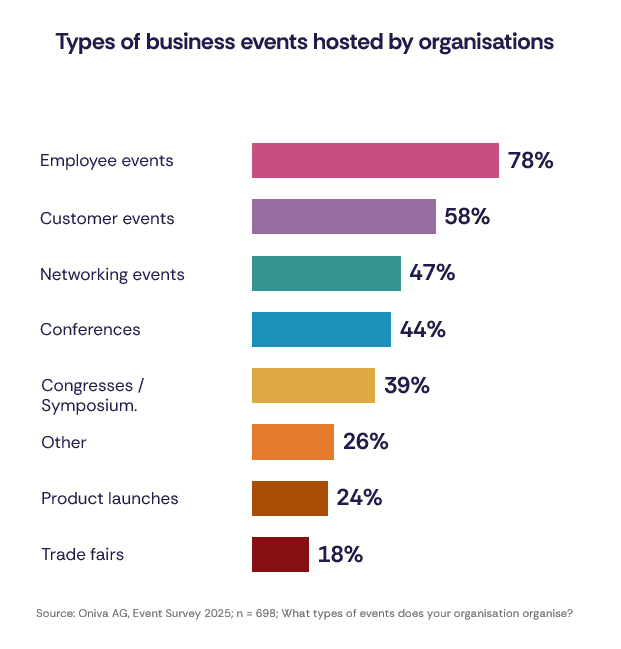
An analysis of the types of events held by organisations reveals a highly diverse event landscape. Notably, employee events are organised by 78% of respondents, highlighting the importance of internal gatherings to foster company culture and collaboration.
Customer events are organised by 58% of respondents. These play a crucial role in maintaining existing client relationships and acquiring new customers. Networking events are also highly significant, representing 47%, underlining the importance of building connections both within and beyond the organisation.
Physical events are once again the most common event format
Despite numerous new technologies for virtualising events, 94% of respondents stated that they organise physical events, which means that they remain the dominant event format. Virtual and hybrid formats have nevertheless successfully established themselves in organisations and complement the event portfolio.

What proportion of the total marketing budget is allocated to events?
Oniva’s analysis shows that the proportion of marketing budgets allocated to events varies significantly across organisations.
Most organisations (24%) spend just 0–20% of their marketing budget on events, while 21% allocate around 21–40%. Only a small percentage dedicate more than 60% of their budget to events.
Notably, 35% of respondents were unable to specify what proportion of their marketing budget is spent on events, indicating a lack of transparency or available data.
These findings highlight that event marketing is prioritised differently across organisations and often represents only a small share of the overall marketing budget.

The primary objectives of events: knowledge sharing, customer and employee engagement, and networking
When it comes to event objectives, knowledge and information sharing rank highest, with 74% of respondents citing this as priority. Close behind, 68% emphasise customer or employee engagement, while 61% prioritise networking, underscoring the importance of interpersonal connections. Only 36% of respondents use events primarily for customer acquisition.

58% of participants stated that they achieve their goals better with events than with other forms of marketing!
One of the core questions in the 2025 survey was whether events help organisations achieve their goals better than other marketing strategies. The results show that events are indeed a highly effective tool. A total of 58% of respondents agree that their goals are better achieved through events, with 25% fully confirming this.
A further 26% believe that events at least partially help to achieve their goals. Only 1% of participants stated that events tend not to contribute to the achievement of objectives. 14% were unable to state whether events achieve the objectives better than other forms of marketing.
This analysis underscores the importance of events as a strategic and central marketing tool for organisations.

Finding the right event venue quickly is one of the biggest challenges
The event date needs to be available, and the venue must align with the event concept—our survey results show that finding a suitable venue is one of the biggest challenges for 47% of respondents. Time and resource constraints follow closely at 44%, with scheduling (35%) and organisational or logistical tasks (35%) also being significant hurdles.

Reliability and trust: The most important criteria for selecting event service providers
Events are unique—they happen at a fixed time and cannot be repeated in the same way. This requires event organisers to exercise the utmost care and attention. As a result, organisations select their event service providers based on well-defined criteria.
Reliability ranks as priority for 81% of respondents, followed by trustworthiness (69%) and having a dedicated point of contact (61%). Other important factors include flexibility, price, and choosing a regional provider, while experience and reference projects are a consideration for just 38%.

Organisations see the key trends for 2025 in sustainable events and artificial intelligence
The findings highlight that sustainability and technology continue to be focal points in event management. The strong emphasis on sustainability reflects the growing corporate and societal desire to organise resource-efficient and environmentally conscious events.
The second-most significant trend, artificial intelligence, demonstrates that organisations are increasingly adopting intelligent tools to create personalised experiences and enhance efficiency.
Innovative event content and digital automation underscore the ongoing evolution of events, making them not only more efficient but also more creative and interactive. Overall, the findings suggest that the future of events lies in a combination of sustainability, innovative technology, and security.

74% of organisations expect to hold the same or more events in 2025
When asked, "How many events is your organisation planning for 2025?" respondents provided insights into their expectations compared to the previous year. A total of 43% stated they plan to hold the same number of events as in 2024. Meanwhile, 31% anticipate an increase, while 13% expect a decline.
These results suggest that most organisations aim for stability in their event planning, reflecting an established event strategy. At the same time, the significant proportion planning more events (31%) signals a positive trend and the growing importance of events in 2025.